
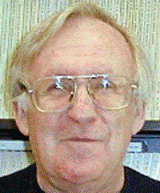
Thomas John Rothenberg
Professor of Economics, Emeritus
Thomas John Rothenberg, Professor Emeritus of Economics at the University of California, Berkeley, passed away on November 4, 2024, from complications of heart disease. He was 87 years old.
Born on March 1, 1937, Tom earned both a B.A. and M.A. from the University of Michigan before starting his Ph.D. at MIT in 1959. After two years of coursework at MIT, he left for the Econometric Institute in Rotterdam in 1961 on a Fulbright Scholarship, returning to the United States in 1963 as an Assistant Professor of Economics at Northwestern University. He joined the faculty at Berkeley in 1966, the same year he received his Ph.D. from MIT. On the Berkeley campus Professor Rothenberg served on two important arms of the Academic Senate: The Committee on Courses and the Committee on Budget and Interdepartmental Relations.
Tom Rothenberg was an influential contributor to research in the field of econometrics, as well as a cherished advisor and mentor to doctoral students in the field, many of whom became prominent econometricians themselves. His early work focused on efficient estimation methods for simultaneous equations models, the workhorse of macroeconomic modeling in the late 1950s and 1960s. In a seminal 1964 article in Econometrica, written with co-author C. T. Leenders, Tom showed the efficiency of the three-stage least squares estimator for simultaneous equation models and proposed a computationally simpler “linearized” alternative to full maximum-likelihood which was also efficient. His work on simultaneous equations and generalized regression models led him to develop a more general theory of identification and efficient estimation of parametric models, reported in a 1971 Econometrica article on identification and a 1974 Cowles Foundation monograph, Efficient Estimation with A Priori Information.
In a related line of research, Tom advocated for the use of higher-order approximations to estimator distributions to differentiate between alternative efficient estimators for parametric models, research summarized in his 1984 chapter in volume 2 of the Handbook of Econometrics entitled, “Approximating the distributions of econometric estimators and test statistics.” His expertise in distributional approximations led to his third main line of research, on “nonstandard” distributional approximations to estimators and test statistics for nonstationary time series models, including an influential 1996 Econometrica article with G. Elliott and J. H. Stock that proposed nearly efficient hypothesis tests for a unit root in autoregressive models. Like his scholarship on parametric identification and efficient estimation, Professor Rothenberg’s research on distributional approximations led to both general theory and applications to methodological problems of empirical interest.
Tom’s contributions as an econometrician were widely recognized by his immediate peers and, eventually, the discipline. In 1977 he was elected a Fellow of the Econometric Society, and in 2015 he was elected a Distinguished Fellow of the American Economic Association. That year many former colleagues and students gathered at Greens Restaurant in San Francisco to celebrate his election.
Following a 2001 conference celebrating Tom Rothenberg’s accomplishments, a festschrift volume in his honor, “Identification and Inference for Econometric Models,” was published in 2005. He wrote the opening chapter of that festschrift, “Incredible structural inference”, which had long enjoyed underground classic status and provides a fine illustration of Professor Rothenberg’s unique ability to make deep points by means of simple examples.
Tom Rothenberg will be remembered not only for his academic achievements but also for his steadfast commitment and sage advice to his students. His former colleague, James Powell, was an undergraduate Economics major at Cal when Tom Rothenberg served as an undergraduate advisor for the department and recalls that “Tom advised me to take the core undergraduate courses in the Statistics department, which was a pivotal moment in my path to a career in econometrics, for good or ill.” Professor Powell also recalls Professor Rothenberg’s quick wit and keen sense of humor. “In discussing his early interest in Bayesian econometric methods, Tom said he decided against working in that area because ‘they only had one theorem [the well-known Bayes’ Rule], and that was proved a long time ago.’” One of Tom’s former graduate students, Dr. Samuel Thompson, says that “I remember being enamored with a mathy finance paper. It proposed a complicated improvement for fitting a very simple continuous time model for the dynamics of interest rates. Tom looked at it and said, ‘they're making a third-order refinement to a model that is first-order wrong.’ That statement has become one of my mantras. To this day I use it at work.”
Tom’s impact on the field of econometrics was profound. His published work set standards for elegance and rigor, while his graduate-student advising helped shape a generation of influential researchers. Tom retired in 2001 but continued to teach as a recalled professor until 2005.
He is deeply missed by all who knew him.
Bryan Graham
Michael Jansson
James Powell

