
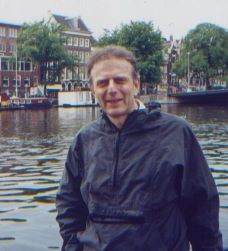
Seymour I. Schwartz
Professor of Environmental Science and Policy, Emeritus
Dr. Schwartz arrived in the founding group of faculty for the newly created Division of Environmental Studies in 1970. He contributed substantially to the original and current structure and philosophy of the Division, now named the Department of Environmental Science and Policy. He made exceptional contributions to the design and fostering of the undergrad major in Environmental Planning and Policy Analysis and to the similar focus area in the Graduate Group in Ecology.
Professor Schwartz’s research focused on three topics: Throughout his career he worked on air pollution and hazardous waste issues, covering both policy design and policy evaluation (primarily the economic effects of regulatory programs). This was important work because California was then, and is now, a global leader in pollution regulation. His hybrid background combined electrical engineering and operations research with the broader field of systems engineering. This training allowed Professor Schwartz to perform detailed evaluations of pollution controls, including their economic impacts on affected industries and individuals. Schwartz’s research was published in the best journals in this emerging field.
In the 1980’s he also worked on the public policy analysis of land use controls, including both stages: policy adoption and policy evaluation. Again, this required a broad set of skills, including political science, engineering, and economics. Some of his papers developed novel methods for modeling the impacts of zoning, tax incentives, and transfer of development rights policies on land values, housing production, and housing costs. Schwartz usually performed evaluations of aggregate (market) economic impacts along with equity analyses of the effects on households by income class. Several papers applied longitudinal statistics, a novel approach at that time, to evaluate the effects of these policies. Again, California was a leader in innovative land use policies during this period and so his papers had an impact on many other states. This work was published in excellent journals.
In the 90s, Dr. Schwartz continued his work on pollution controls but moved his land use focus onto more complex local policies. One was “affordable housing” requirements. These were a new idea, requiring residential developments to include a percentage of units with controlled rents or sales prices (usually tied to countywide household median income). Also, this work focused on “local growth controls” where cities restricted the number of housing permits granted annually and on density bonuses, where the local government grants higher density (more units) to projects that include public benefits. These were controversial new policies being adopted in a few California cities and Dr. Schwartz’s early policy evaluation papers were timely. Some of these papers were methodological, focused on complex statistical methods required to evaluate policy effects in complex real estate markets. As always, this work was published in the best journals.
Professor Schwartz’s teaching was uniquely valuable, in terms of careful preparation, but also in that he progressed over his career to a style of “active learning” where the students work in groups on many small projects. He felt that this was a better way to train students for critical thinking and for group work situations. As part of active learning, he believed that instructors should not give students answers, but let them find answers on their own, after being given the history of an issue and various policy analysis tools. Professor Schwartz used this style in our intro course, ESP 1, and this attracted students to this major. Basic to policy analysis, in his teaching, was to develop a systematic description of the problem using methods from systems engineering. In upper division classes, he and other faculty built on this foundation and taught various types of quantitative modeling. Schwartz started the “Active Learning Group” on campus in 1996 and slowly got the Teaching Research Center interested in this approach. He received the Academic Senate Distinguished Teaching Award in 1995. After these accomplishments, he was asked to teach workshops regularly at the TRC.
In the classroom, Professor Schwartz was always well-prepared and organized. His classes were models of careful teaching and focus on the student. In the late 70s, he was a leader in the development of our undergrad major, Environmental Policy Analysis and Planning, which has high enrollments. He wrote and maintained the handbook for the major. He also led the committee that revised and formalized the policy Area of Emphasis in the Ecology Grad Group, a large group of faculty and students. Our students remember Professor Schwartz, when they think back on their time at UCD. He was the master advisor for decades and attended all of the graduations and graduation brunches with parents.
Dr. Schwartz’s classes were foundational for the policy analysis major, in that he taught classes where basic methods of policy evaluation were revealed. In the U.S. public policy evaluation is the consensus approach and uses interest group analysis to define population groups that will be differentially affected by any policy change. He taught the basics of benefit-cost analysis but emphasized the limitations of those methods in terms of excluding noneconomic impacts. Other faculty coordinated their courses so that the major taught broad public policy evaluation methods in general and in specific settings.
Many of Professor Schwartz’s service contributions have been covered above in the context of instruction. In addition to expanding the TRC program to include Active Learning, he also was a mentor for professors and students there. He wrote and presented the Department’s policy major 7-year review, which helped burnish our reputation. Schwartz was a reviewer for the University of California Press. He was an informal advisor to several offices in State government dealing with pollution.
Through more than three decades at UC Davis, Professor Schwartz shaped the Department of Environmental Science and Policy in enduring ways. He was also a ceramics instructor at the UC Davis Craft Center into his 80’s. He was preceded in death by his wife Edie and survived by his brother, two sons, Andy and Steven, and four grandchildren.
Bob Johnston
Ted Foin
Ben Orlove

