
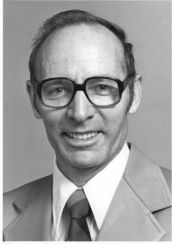
Roger E. Garrett
Professor of Biological and Agricultural Engineering, Emeritus
Roger E. Garrett, Professor of Biological and Agricultural Engineering at the University of California, Davis, was highly influential in reshaping education, research, and the agricultural engineering profession around the broader field of biological engineering. Roger passed away on Friday, December 16, 2022, in Macon, Missouri, at the age of 91. We on this committee tasked with writing his memorial, and our various departmental colleagues, were guided by Roger’s clear vision of the future and leaned heavily on his sturdy shoulders during the fog of our early years on campus.
Roger was a leader in transforming the American Society of Agricultural Engineers (ASAE) into the American Society of Agricultural and Biological Engineers. This transformation went far beyond name change and effectively remade the Society. Today our department, and the entire profession, reflects Roger’s vision for research and education in biological systems engineering. From the single Agricultural Engineering major originally offered, the department now provides two majors – Biological Systems Engineering in the College of Engineering, and Agricultural and Environmental Technology in the College of Agricultural and Environmental Sciences. The breadth of the department’s current research reflects changes initiated through Roger’s inspiration and guidance.
Roger was born in the depths of the Great Depression on September 23, 1931, in the small town of Early, Iowa. In December 1941, his family moved to a farm in the Ozark mountain area of central Missouri. The farm was diversified and largely self-sufficient, supplying feed and pasture for a small herd of dairy cattle and a few hogs and chickens. This experience immersed him in the transition to mechanized farming and taught him some of the benefits and potential problems.
Roger joined the army and served for two years in Korea, qualifying him for support under the GI bill. He entered the University of Missouri, Columbia in 1954, and received a BS in Agricultural Engineering in 1958 and an MS in 1959. Roger chose the field of Agricultural Engineering because, as he stated, “I wanted to help the farmers.” During college, he was active in the Wesley Foundation of the United Methodist Church, where he met Marylyn Marsh. They married in June 1957. After graduation, Roger spent three years working for John Deere at the Waterloo Tractor Works and later at the Tractor Research and Engineering Center in nearby Cedar Falls. The work involved testing tractor and implementing combinations for compatibility in developing tractor hydraulic systems. Looking beyond short-term solutions and seeking deeper understanding of agricultural development and mechanization, Roger joined the faculty of UC Davis in 1962.
At UC Davis, he first tackled problems of lettuce harvesting and developed mechanisms for identifying, cutting, and picking mature lettuce heads. A commercial prototype harvester employing his devices was built, but a market for the machine did not develop due to the continued availability of farm labor. However, his innovations found other applications. He developed a synchronous thinner, this time commercialized by John Deere for use in sugar beets and tomatoes with what may have been the first use of electronics in agriculture. From 1968 to 1970, Roger completed a PhD at Cornell University, investigating pulsed sound for nondestructive testing of fruit quality. This research helped coalesce his thoughts around the engineering of biological systems. His insight, technical proficiency, and general approach toward biological systems allowed the extension of his research into other areas, including engineered environments and farmed systems in aquaculture, and fluid-mechanical systems for seed encapsulation and handling.
In January 1977, Roger began a ten-year term as chair of the Department of Agricultural Engineering, immediately facing demonstrations opposing the University's role in mechanization research. For the next several years, he served as an unofficial spokesperson for the profession in attempting to address and balance the many issues surrounding fundamental changes in specialty crop production, and agriculture in general. These issues continue today.
Under his leadership as chair, the department began a period of renewal as positions were vacated by retirement of faculty hired immediately after World War II. New faculty were recruited in emerging areas of engineering, including aquaculture, food processing, renewable energy, forestry, soil and water, environmental quality, automation, and human factors.
Roger had a major impact on the development of the biological engineering discipline. He brought together teachers from across the US and Canada to prepare a framework for a curriculum, detailed outlines for five biological engineering core courses, and completely developed key courses, including a sophomore-level course that introduced students to the properties of materials in biological systems. The latter paralleled traditional engineering courses focused on inanimate materials. He served as District Director on the Board of the ASAE and was chair of the Biological and Agricultural Engineering Division of the American Society for Engineering Education. He frequently served as a reviewer of Agricultural and Biological Engineering curricula for the Accreditation Board for Engineering and Technology and as a reviewer of university programs for the USDA Cooperative State Research, Education, and Extension Service.
Following 32 years of service to UC Davis, Roger retired on July 1, 1994. He then started several new projects in Atlanta, Missouri, his wife’s hometown. With Marylyn at his side, he transformed the old family meat processing plant and locker into a beautiful original restaurant and event location. They also designed and implemented a children’s park, which was then gifted to the community. Roger continued his involvement in the United Methodist Church for many years, including singing in the church choir well into his 80s.
Roger leaves a legacy of sustained influence on the university, his profession, and the communities where he lived.
Michael Delwiche, Bruce Hartsough, David Hills, Bryan Jenkins
2025

