
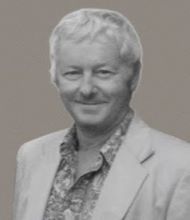
Michael John Chamberlin
Professor of Biochemistry
Michael John Chamberlin was born in Chicago on June 7, 1937. During his school years, his family moved to Hawaii before returning to Chicago for his high school years. The single most consistent description of Mike is the intensity he brought to all dimensions of his life. His early scholastic success earned admission to Harvard, from which he graduated with a degree in Chemistry. Following graduation, he joined two of his fellow Harvard graduates, William Wood and Elliot Elison, constituting the entire entering class of the then new Biochemistry Department at Stanford Medical School in 1960, led by Arthur Kornberg.
Chamberlin selected Paul Berg as his thesis advisor (Nobel Prize in 1980) near the dawn of a field that would become known as Molecular Biology. Francis Crick had only recently formulated what is now known as the Central Dogma of Molecular Biology. The Central Dogma states that the genetic information written in DNA is copied into messenger RNA, which is then the template from which proteins are translated by the ribosome. One of Chamberlin’s thesis committee members, Arthur Kornberg (Nobel Prize in 1959) had recently found the first enzyme capable of synthesizing DNA. Chamberlin set out with the audacious goal as a new graduate student to find the enzyme capable of making RNA from DNA . Within two years he had found the enzyme which would ultimately be called RNA polymerase (Chamberlin M and Berg, P Proc Natl Acad Sci U S A. 1962 Jan 15;48(1):81-94).
While still a graduate student, Chamberlin was recruited to join the faculty at the University of California, initially to the Virus Laboratory, before moving to the Department of Biochemistry.
Subsequent biochemical and biophysical studies made by Chamberlin and colleagues established that RNA polymerase is made of four different protein subunits and established a detailed mechanistic understanding of how RNA is transcribed from DNA, and how RNA polymerase engages in each step in what is now called the transcription cycle: promoter selection, initiation, elongation, and termination. This work underpinned later studies (in more than 100 publications) which suggested how transcriptional regulation could occur at each of these steps.
Chamberlin’s initial discovery of RNA polymerase by detecting its activity in extracts made from living cells, so-called in vitro reactions, stimulated related work in labs around the world. Labs in England and at Harvard discovered a protein called Sigma by its ability to stimulate RNA polymerase to higher levels of activity. Chamberlin discovered that rather being a generalized stimulating factor, Sigma provided RNA polymerase the ability to bind to specific DNA sequences known as promoters that spell the initiation sites for RNA synthesis of thousands of different genes in the single long DNA molecule that makes up the entire chromosome of E. coli.
The intensity with which Chamberlin approached science was matched with unrelenting rigor in experimental execution and data interpretation. As one example, there were published reports that the bacteriophage T7 encoded a gene for a sigma factor that would highjack E. coli RNA polymerase to make RNA copies of T7 genes. Chamberlin and colleagues discovered that instead T7 encoded an entirely new form of RNA polymerase made of a single protein molecule (Nature. 1970 Oct 17;228(5268):227-3). This result was surprising in that T7’s RNA polymerase was so structurally and conceptually different from the well-established 4 subunit RNA polymerase of E. coli. Later, other bacteriophage (T3, SP6) were also found to use this strategy of a virally encoded RNA polymerase to transcribe viral DNA using viral specific promoters. The practical importance of these discoveries did not become clear until more than 40 years later when it was found that T7 RNA polymerase could be used to make large amounts of any RNA in vitro. This enzyme has saved innumerable lives because biopharmaceutical companies use it to make the RNA component of vaccines such as the highly successful COVID vaccines used by many millions of people around the world. In those early days before the biotechnology industry was established, the Chamberlin lab did not even consider filing a patent application for the discovery of T7 RNA polymerase.
The Chamberlin laboratory was a training ground for many who went on to distinguished careers in academia and the biopharmaceutical industry. Who was allowed to join the lab was often a mysterious process. He was a very challenging mentor - extremely demanding about everyone’s science but also incredibly loyal to the people in the lab. Outside presentations were dissected line by line by the entire group; internal group meetings and literature reviews were battlegrounds of ideas which sometimes led to shouting matches (https://lifescivc.com/2025/11/everything-i-know-i-learned-in-graduate-school/). This environment raised everyone’s standards as to how science should be done. Nothing could be taken for granted. Every reagent had to be extensively characterized smf these were often shared across members of the lab (and occasionally outside collaborators) which meant that they had to be pristine. Most of this work was physically demanding, completed prior to the availability of many molecular biology technologies (PCR, DNA synthesis, high throughput DNA sequencing) which are routinely used today, substantially easing the production of these reagents. Along with the intense science, there were lab outings for abalone dives, long runs in Tilden Park, and pot-luck dinners at his house. Mike supported his undergraduate students, graduate students, and post-docs in their next steps in their careers, whether in academic molecular biology or biotechnology or law or finance or medicine.
Former Ph.D. students include Robert Kingston (Harvard), Karen Arndt (U. Pittsburgh), Alice Telesnitsky (U. Michigan), the late Tom Kerppola (U. Michigan), the late Tom Kadesch (U. Pennsylvania), John Helmann (Cornell), David Arnosti (Michigan State), Leticia Márquez-Magaña (San Francisco State), and Tracy L. Johnson (UC San Diego). Mike also trained many Berkeley undergraduates who have gone on to successful careers and leadership positions, including Suzanne Pfeffer (Chair of Biochemistry, Stanford) and David Drubin (Chair of MCB at Berkeley) as well as Joon Yung Lee (University of Pittsburgh).
Even with the clarity of hindsight, it is hard to imagine, given the commitment he had to teaching and research, how Mike found the time for his other passions in life. While still at Harvard, he took up car racing. While a graduate student, he became an AKC-certified dog trainer. While on the Berkeley faculty, he was an accomplished whitewater boatman, winning the National Championship in the two-person decked canoe in 1975. His kayaking descent of a waterfall on the North Fork of the American River, in a kayak he constructed, was captured on film and used for training purposes by the Sierra Club. Mike’s descent was so epic in execution that the waterfall now carries Chamberlin Falls as its official name. In later years, he took up distance running, completing two full marathons, and returned to an intense re-engagement with his early passion for golf.
Chamberlin was engaged in professional and academic service throughout his career. He was a member of the American Society for Biological Chemistry for nearly 60 years, serving on the editorial board of its flagship journal. At Berkeley, he created and taught a graduate course called The Biochemistry of Nucleic Acids to generations of graduate students. He was vice-chairman of the Department of Biochemistry from 1983 to 1988 until the reorganization of the biological sciences at Berkeley restructured the department organization. With his wife Caroline Kane, they established The Michael Chamberlin and Caroline Kane Directorship to support the Biology Scholars Program (BSP) at UC Berkeley, which has helped to date approximately 4000 students from diverse backgrounds succeed in the biological sciences.
He was an elected member of the National Academy of Sciences (1986) and the American Academy of Arts & Sciences. His research was recognized by the Pfizer Award in Protein Chemistry (1974). His research and mentoring were recognized by the Sigma Xi Monie A. Ferst Award (2001). In 2021, the Stanford Medicine Alumni Association honored Chamberlin with the Arthur Kornberg and Paul Berg Lifetime Achievement Award in Biomedical Sciences.
Chamberlin died 1 November 2025 at age 88.
Jasper Rine
Steve Rosenberg
February 18, 2026

