
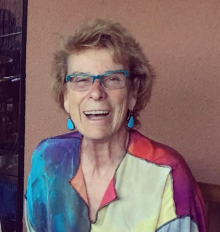
Mary-Kay Gamel
Professor Emerita Literature
Professor of Classics and Literature Mary-Kay Gamel died on June 29, 2024. She came to UCSC as an Assistant Professor in 1973 and retired after 42 years of teaching in 2015. A role model and source of inspiration for innumerable students during these years, she was a major figure in the emergence of the now thriving scholarly discipline of performance studies, with her primary focus on the modern performance of ancient plays. This development is indebted to her work as a translator, producer, and director, to her scholarly publications and to the energy and personal commitment she brought to the work.
Mary-Kay was born in Springfield, Massachusetts in 1942. Her parents were Blanche Lee Booker and Oscar Young Gamel who met in Trinidad, Colorado, where he was a high-school teacher. Mary-Kay enjoyed an excellent education at the Springfield Classical High School, where she began to develop her life-long love for music after a favorite teacher took students to the Metropolitan Opera to see a production of Tosca. She was strongly tempted by the Rhode Island School of Design but accepted instead a full scholarship to Smith College, where she found her calling to Greek and Latin literature.
After her B.A. in Classics at Smith (1963) and her M.A. at Harvard in Classics (1964) she went to UC Berkeley for her Ph.D. in Comparative Literature (1972) and won a highly prestigious two-year fellowship to the American Academy in Rome. After Rome she joined the Classics Faculty of Boston University where she taught for four years, first as Instructor then Assistant Professor. In 1973 she was appointed Assistant Professor of Classics and Comparative Literature at UCSC where, with her colleagues John Lynch and Gary Miles, she established a remarkably successful Classics Program, offering a full range of classes in Greek and Latin literature, as well as a concentration in Western Civilization.
Mary-Kay’s academic record includes fifty-four theatrical productions in which she was either Director, Producer, Co-director, Translator, Script Consultant, dramaturg or a combination of two or three of these roles. This record was made possible by her skill and persistence in obtaining awards and grants for staging productions. She also obtained substantial grants for organizing conferences and seminars, including two major grants from the National Endowment for the Humanities. Her theater activity earned her an international reputation with invitations to stage productions at a wide variety of national and international venues.
Her productions were about as far away as one can imagine from the “toga” productions that had come to define ancient drama. Her aim was not to be “true” to the ancient text (an impossibility) but to allow the text to speak most effectively to modern audiences by finding a current mise en scène comparable to the ancient one. Consequently, she began experimenting with producing “versions” of the plays early on. A few examples: in 1986, Sophocles’ Ajax was set in Vietnam, with Ajax as a “Rambo” figure; in 1992 Aeschylus’ Eumenides (The Furies) was set in the American fifties, characterized by the then-rampant “family values” and antifeminism; in 1996 Eye on Apollo (a version of Euripides’ Ion) was presented as a commentary on the abuses of power in global capitalism; in 2000, Aristophanes’ Thesmophoriazousae became The Julie Thesmo Show in which a Greek women-only religious festival was reconceived as a daytime TV talk show; in 2004, Iran Man, based on Plautus’ Persa, explored ethnic and gender stereotypes in contemporary political discourse; and in 2006 The Buzzzz!!!! (a version of Aristophanes’ Wasps) was set in the Cowell College Provost’s residence where the Chancellor and other well- known local figures had roles and played their own parts.
Her many publications include two important co-edited volumes, Ancient Mediterranean Women in Modern Mass Media and Women on the Edge: Four Plays by Euripides, with substantial and innovative introductions to the study of gender in antiquity and its reception in modern popular media forms. A major contribution to the field that she helped to create are her articles on “authenticity” as both a challenge and a provocation in presenting ancient works for modern audiences. A much sought-after reviewer of books in a variety of fields, she gave hundreds of lectures in public forums and scholarly conferences. Somehow, she also had the time to provide extraordinary service to the University. In addition to chairing the departments of Literature, Theater Arts, and the Language Program, she chaired or was a member of numerous departmental, divisional, and Senate committees over the course of her career.
Mary-Kay was a legendary teacher, characterized by her passion for Classics and her ability to instill that passion in her students, who were often invited to her home to enjoy a wonderful meal and continued conversations about topics that ranged from the academic to the political. She encouraged many of her undergraduate students to pursue graduate degrees in Classics. Thanks to her, several enjoyed successful academic careers. Her strengths as a teacher were recognized early on in an article in People Magazine (10/13/1975) where she was one of 12 “Great U.S. Professors (who) agree that an interested student is what their job is about.” The article’s prediction that “Because of these great teachers, some students’ lives will be forever changed” was, in her case, fulfilled many times over.
Mary-Kay is to receive posthumous recognition for her many contributions to the field of Classics. The Society for Classical Studies, the principal organization of North American Classicists, will be awarding her its annual Outreach Prize for “outstanding projects or events by an SCS member or members that make an aspect of classical antiquity available and attractive to an audience other than classics scholars or students.” She had previously shared this honor (2009) with Peter Meineck of Aquila Theatre Company “for their efforts to bring classical drama to general non-professional audiences.” In addition, a special edition of Illinois Classical Studies in honor of her work is scheduled to appear in spring 2026.
Professor Gamel is survived by her husband, UCSC Professor Emeritus Thomas Vogler, her brother and sister-in-law, John and Beth Gamel, and four stepsons: Matt, Hank, Jeremy and Thad Vogler.
κούφα σοι χθὼν ἐπάνωθε πέσοι
Sit tibi terra levisMay the earth rest lightly upon you

