
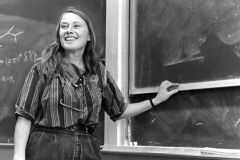
Mary K. Gaillard
Professor of Physics
Mary K. Gaillard, Professor Emerita of Physics, passed away on May 23, 2025. A UC Berkeley professor emerita of physics and faculty senior scientist emerita at Lawrence Berkeley National Laboratory, she was 86.
Born in New Brunswick, New Jersey in 1939, Professor Gaillard knew she wanted to be a physicist since she was a teenager and pursued that dream despite the fact that women in the 1960s and ’70s were not always welcome in the field. She received a full scholarship to Hollins College (now University) in Roanoke, Virginia, and did two summer internships at Brookhaven National Laboratory on Long Island, New York. There, she also met her husband, Jean-Marc, also a physicist. After graduation, Gaillard was accepted to Columbia for graduate studies, but she followed Jean-Marc to Paris, France, in 1961. In France, Professor Gaillard set out to pursue her doctorate but was rejected as a graduate student by numerous male scientists who told her that women could not do physics. Eventually, she found a mentor willing to work with her, and she received her first doctorate from the University of Paris in Orsay.
In 1964, her husband took a six-year appointment at the European Organization for Nuclear Research (CERN) — Europe’s main hub of high energy particle. While raising three children, she dove into the theory of elementary particles and worked on her second doctoral thesis, which she defended in 1968 — two months after the birth of her third and last child. She remained a visiting scientist at CERN until 1981, when she moved to UC Berkeley and became the first woman to join the Physics faculty and became a senior staff member at the Lawrence Berkeley National Laboratory. She headed Berkeley Lab’s Particle Theory Group from 1985 to 1987.
When she moved to Berkeley, Professor Gaillard separated from her husband, and they later divorced. She had started collaborating with Bruno Zumino, one of the originators of supersymmetry — the idea that all particles have a twin with different spin. Zumino eventually followed her to Berkeley and they later married.
Professor Gaillard’s career as a theoretical physicist spanned the period from the inception, in the late 1960s and early 1970s, of what is now known as the Standard Model of particle physics and its experimental confirmation, culminating with the discovery of the Higgs particle in 2012. She taught physics to thousands of students and conducted ground-breaking research in the field of theoretical particle physics. By predicting the mass of the charm quark (with Benjamin W. Lee), 3-jet events (with John Ellis and G.G. Ross), and b-quark mass (with Mike Chanowitz and John Ellis), Mary K blazed a trail of research and discovery. Her significance in the field was recognized through the E.O. Lawrence Memorial Award and the J. J. Sakurai Prize for Theoretical Particle Physics. She was a fellow of the American Academy of Arts and Sciences, a member of the National Academy of Sciences, and a member of the American Philosophical Society. She served on several committees of the American Physical Society, advisory panels for the Department of Energy and the United States National Research Council, and on advisory and visiting committees at universities and national laboratories. She was a member of the National Science Board from 1996 to 2002.
Mary K, as she was known, served as a role model to many female scientists in the Berkeley Physics Department and throughout the world. Throughout her career, she faced widespread gender discrimination on both professional and personal levels, as detailed in her 2015 memoir, A Singularly Unfeminine Profession One Woman’s Journey in Physics. Her perseverance in overcoming prejudices serves as an inspiring model of women in science, for us today and for future generations. Gaillard supported young physicists internationally, co-directing the 1981 Les Houches Summer School in Theoretical Physics on Gauge Theories in High Energy Physics in France. She served on the American Physical Society’s Committee on the Status of Women in Physics (CSWP) as a member from 1983 to 1985 and as the chair in 1985. At UC Berkeley, she mentored numerous graduate students in advanced topics like supersymmetry and supergravity throughout her tenure and after her retirement. When asked once in a public event for advice to young female physicists today on how to navigate those waters she answered: “you just need to love physics enough, for it to be a true passion for you, and keep dismissing all that and just do it, disregard all that nonsense and go ahead with your research’’.
“Mary K was a theoretical physicist of great power, gifted with both deep physical intuition and a very high level of technical mastery,” her colleague Michael Chanowitz, a faculty scientist at Berkeley Lab, wrote in a memorial. “She pursued her love of physics with powerful determination, in the face of overt discrimination that went well beyond what may still exist today. She fought these battles and produced beautiful, important physics while raising three children as a devoted mother.”
Professor Gaillard is survived by three children — Alain in France, Dominique in Seattle and Bruno in the Bay Area — seven grandchildren and her former husband, Jean-Marc Gaillard. Her second husband, Bruno Zumino, died in 2014. Her brother, George Ralph, died in 1997.

