
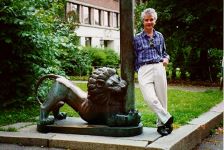
Kjell Doksum
Professor of Statistics
Kjell Doksum died on November 20, 2021, at the age of 81. He was Professor Emeritus of Statistics at the University of California, Berkeley, and Senior Scientist at the Statistics Department, University of Wisconsin, Madison. Kjell was born in Sandefjord, Norway, and grew up in Oslo. His parents were Filip Doksum and Elise Olsen, and he had two brothers. He is survived by his wife, Joan Fujimura, a distinguished scholar in Sociology of Science, and his two daughters, Joan and Kathryne, from a previous marriage to Maria Doksum.
Kjell received his Master’s degree in Statistics from San Diego State College in 1962, where he worked with Chuck Bell, one of the few African American statisticians at the time. He then moved to the University of California, Berkeley, where he completed his PhD in 1965 under the supervision of Erich Lehmann. After a year as a postdoc in Paris, he joined the Berkeley Statistics department, where he spent most of his academic career. He took early retirement in 2002 and moved to the University of Wisconsin, together with his wife Joan, who was recruited by the Department of Sociology. He retired from Wisconsin in 2010 and remained there as a Senior Scientist. He held visiting positions at the University of Paris, the University of Oslo, the Norwegian Institute of Technology in Trondheim, Harvard University, Columbia University, the Bank of Japan, Hitotsubashi University in Tokyo, and Stanford.
Kjell made pioneering contributions to statistical theory and methodology, covering various areas: randomization methods, nonparametric and rank-based inference, survival and reliability analysis, semiparametric techniques, transformation models, probability measures, and Bayesian inference. In early collaboration with Chuck Bell, he developed a randomization procedure. He showed that the resulting Gaussian randomized tests were asymptotically more powerful in non-normal situations than the classical ones. He returned to this topic by proposing a Monte Carlo approach for partial likelihood inference for semiparametric models. In the early 1970s, Kjell introduced the shift function as a nonparametric functional measure of difference between distribution functions and, in a series of subsequent papers, developed inference procedures. He was still working with a student on extending this approach to regression settings at the time of his death. In one of his most cited papers, Kjell proposed the well-known “neutral-to-the-right” processes and developed their properties. These processes are very useful in nonparametric Bayesian inference.
Kjell’s joint work with Peter Bickel provided deep insights into the statistical properties of procedures based on transformed data. In joint work with Steinar Bjerve and others, he introduced the concept of local correlation in a nonparametric regression framework. He proposed, jointly with Arnljot Hoyland, a new class of degradation models for reliability and life testing. He and his co-authors also contributed essentially to survival and censored data analysis. The Festschrift volume organized for his 65th birthday, “Advances in Statistical Modeling and Inference: Essays in Honor of Kjell A. Doksum” (2006), edited by Vijay Nair, covered contemporary results on all these research areas. Many graduate students at Berkeley and elsewhere learned their statistics theory and methods from Kjell’s book, co-authored with Bickel, “Mathematical Statistics: Basic Concepts and Selected Topics Volumes I and II,” published by CRC Press.
Kjell supervised 24 PhD students and several undergraduates. He served on the editorial boards of JASA, the Scandinavian Journal of Statistics, Life Data Analysis, and Sankhya. He was the Executive Secretary of IMS and played a key role in founding the IMS journal Statistical Science. For his contributions, he was elected a Fellow of ASA and IMS, an elected member of ISI, and a foreign member of the Royal Norwegian Society of Sciences and Letters.
Kjell was a fierce advocate for social justice. He had developed an integrity and a moral strength that carried him through many adversities, beginning with his mother’s early death and the Nazi occupation of Oslo during his early childhood. Kjell leaves behind a loving family: wife Joan; daughters Teresa and Kathryn; grandchildren Matthew, Kevin, Emma, and Calvin; nephews and cousins in Norway; sister-in-law in Denmark; and Joan’s mother, brothers, their families, and cousins in Hawaii who all adopted Kjell as one of their own.
Vijay Nair

