
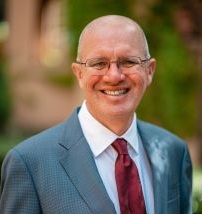
Kenneth W. Tate
Professor of Plant Sciences
Kenneth Tate, professor and Cooperative Extension specialist in the Department of Plant Sciences at the University of California, Davis, died unexpectedly at the age of 58 on June 5th, 2025. Ken spent his formative years in Norman, Oklahoma, graduating from Norman High School in 1985. As a first-generation college student, he earned an A.S. in Range Management from Northeastern Oklahoma A&M College (1987), then went on to Oklahoma State University where he completed a B.S. (1989) and M.S. (1991) in Range Ecology and Management and a Ph.D. in Water Resources (1995). After finishing his Ph.D., Ken immediately joined the UC Davis Department of Agronomy and Range Science in April 1995 as an assistant rangeland watershed specialist in Cooperative Extension.
Throughout his career, Ken tackled a wide range of agricultural and environmental challenges across California’s 30+ million acres of rangelands. He successfully built and led a myriad of interdisciplinary teams to examine management impacts on key ecosystem functions—from individual plots to entire ranches and watersheds—and sought ways to enhance conservation outcomes and agricultural benefits, including ranch productivity and profitability.
Ken possessed a unique ability to bring together diverse partners and build consensus, even on highly controversial issues—starting with rangeland water quality and human health. Early in his career, he was called upon to advise public interest groups on the risk of pathogenic contamination of San Francisco’s drinking water supply. In an innovative collaboration with the School of Veterinary Medicine and UC Cooperative Extension, Ken and his colleagues brought together divergent stakeholder groups to collectively identify rangeland management practices that reduce the risk of livestock-borne Cryptosporidium parvum contaminating drinking water supplies. This groundbreaking effort ultimately enabled seven ranching families to continue their operations using sustainable grazing practices on watersheds east of San Francisco.
In the years that followed, Ken led a series of science-management collaborations to investigate the prevalence, transport, and fate of pollutants—including pathogenic protozoa and bacteria, water quality indicator bacteria, and hormones and pharmaceutical products associated with rangeland cattle production. Building from this extensive body of work, Ken brought together a team of scientists, resource managers, and ranchers to collectively translate scientific knowledge into a practical suite of rangeland management practices and monitoring tools to maintain and protect clean water.
Ken was well known for innovating and adapting his program to meet critical stakeholder needs at the intersection of science, policy, and management. He was a leader in working with both state and federal agencies to provide research-based solutions, which were regularly adopted and integrated into agency policy directives and site-specific habitat conservation strategies. Building on his long history of collaborative work, Ken also sparked interdisciplinary partnerships that integrated ecological, social, and economic approaches to address broad challenges around rangeland sustainability—reaching across disciplines and beyond conventional scales of research.
More recently, Ken had once again pivoted his program to meet urgent stakeholder needs—this time, taking on the high-stakes challenge of human-livestock-predator conflict. He teamed up with his wife, UC Cooperative Extension livestock and rangeland economics specialist Tina Saitone, to launch a new research initiative to quantify the indirect costs of the expanding grey wolf population on cattle and ranching operations in California. As the first study of its kind in the state, this work generated essential data to inform current policy debates and will continue to guide management and decision-making in predator-affected landscapes well into the future. This project exemplified Ken’s steadfast belief in taking challenges head-on—not walking away simply because they are hard or the solution seems out of reach, but instead working collaboratively with the community and continuing to “follow the data.”
Ken’s commitment to working with ranchers in rangeland research and conservation earned him the prestigious inaugural appointment to the Russell L. Rustici Endowed Specialist in Rangeland Watershed Science. The endowment, created by Lake County cattle rancher Russ Rustici, was established to support collaborative, science-based solutions to protect and enhance California’s rangelands. Ken exemplified Rustici’s vision, earning his respect early in his career and becoming a key leader for many multidisciplinary teams addressing critical rangeland challenges. During his time as holder of the endowed chair, Ken leveraged the funds to drive applied research with real-world impact, create new outreach and education platforms, and invest in the next generation of professionals. In 2012, he launched the UC Rustici Rangeland Science Symposium, a biennial event that convenes 200 to 400 leaders in rangeland science, management, and policy to advance meaningful changes for California's rangelands. Ken deeply cared about the Rustici Endowment and continued to serve as the CA&ES Dean’s Designee for the Russell L. Rustici Rangeland and Cattle Research Endowment until his passing.
Ken’s wide-ranging and impactful program, his ability to connect people with science, and his invaluable service to both the university and the range management community earned him frequent recognition from colleagues and ranching partners alike— including the UC Davis Distinguished Service Award, the Society for Range Management’s W R. Chapline Land Stewardship Award, and the Upper Feather River Watershed Group’s Silver Shovel Award. Ken’s legacy also includes more than 50 graduate students, postdocs, and researchers, as well as more than 100 undergraduate students who gained practical experience through laboratory and fieldwork opportunities. Ken was also a dynamic and well-loved teacher, inspiring both undergraduate and graduate students in his rangeland management courses. Many of his former mentees and students are now leaders in rangeland science, management, and conservation.
Ken’s tribute page (https://www.online-tribute.com/KennethWTate) is filled with memories highlighting the enduring mark he has left on so many. Faculty, staff, students, friends, and ranching and conservation partners remember him as a scientist of integrity and vision, a dedicated mentor and teacher, and a genuine and grounded human being. Ken is survived by his wife Tina Saitone, daughter Neri, mother Carolyn, sister Pamela, nephews Nathan, Noah and Johnathan, and extended family members. He also leaves behind a community of collaborators, colleagues, and friends who were profoundly impacted by his leadership, friendship, and heart.
Leslie Roche
Melvin George
Jennifer Funk
Chris van Kessel

