
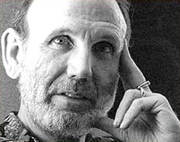
David Howell Cope
Professor Emeritus of Music
David Howell Cope (May 17, 1941 – May 4, 2025) leaves behind a remarkable legacy as a composer, author, professor, and pioneer in the field of computer-generated music. Known in later years as the “Godfather of AI Music,” Cope’s career was defined by his groundbreaking work in algorithmic composition and artificial intelligence. As a long-time professor at UC Santa Cruz, his influence extended well beyond the classroom, shaping how musicians and computer scientists think about creativity and the very nature of musical authorship.
A defining moment came in 1981 when, while struggling with writer’s block on an opera commission for the Cornell New Music Ensemble, Cope devised a novel compositional approach. He translated his musical ideas into generative code that could be altered experimentally to produce a desired result. This approach led to Cope’s most famous algorithm, Experiments in Musical Intelligence (EMI), which analyzed existing music and recombined the “signatures”—the characteristic thematic and stylistic fingerprints of a composer—into new compositions.
Initially, Cope used EMI to create music informed by his own compositional “signatures”. This collaboration between human and algorithm enabled Cope to complete not only his opera for the Cornell New Music Ensemble but also hundreds of other original works over the years. In a parallel endeavor, Cope designed much of his work with EMI to audibly emulate the styles of recognizable composers other than himself. Among the twenty plus commercial recordings and hundreds of worldwide performances of Cope’s work can be found titles such as Bach by Design, and Classical Music Composed by Computer which include examples of music in the styles of Bach, Beethoven, Chopin, Joplin, Rachmaninov and other masters—examples which often fool expert listeners as to the actual composer in musical Turing tests.
In coordination with his compositional work, Cope produced an extensive body of scholarship. Through multiple updates/editions over the course of a quarter century, his New Directions in Music (1971-1998) served as an important reference for students at many levels. His most influential scholarly books include Computers and Musical Style (1991), Experiments in Musical Intelligence (1996), Techniques of the Contemporary Composer (1997), Virtual Music: Computer Synthesis of Musical Style (2001), and Computer Models of Musical Creativity (2006). In 2022, he published Ethics of Computer-Assisted Music, reflecting his enduring interest in the ramifications of technology for creativity and morality. These works document not only the evolution of his algorithms but also the broader implications for artistry in the digital age.
David’s work provoked debate and fascination around the limits of human creativity—a subject he explored not only through technology, but also in dozens of books and public lectures. He was an advocate for seeing computers as creative partners, not mere tools, and continued writing music in collaboration with algorithms for much of his career. Even as critics questioned the artistic value of infinitely reproducible AI compositions, Cope remained committed to showing how computational systems could illuminate, expand, and support human ingenuity.
Still, David Cope’s influence reached far beyond algorithms. He was a versatile composer in his own right, comfortable in traditional orchestral forms as well as avant-garde experiments and microtonal explorations. He was also a dedicated educator, remembered for his warmth, curiosity and insistence that his students take risks in pursuit of their ideas. His endless curiosity and creativity led him to write novels, memoirs, screenplays, and poetry, to pursue his study of astronomy, and to explore other artistic media such as photography, algorithmically produced visual artworks, and the creation of new board games.
David is survived by his wife of 57 years, Mary Jane, four sons (Tim, Stephen, Brian, and Gregory) and four grandchildren. He leaves behind a legacy that transcends disciplines. His music, his writings, and his teaching continue to challenge how we think about authorship, originality, and the mysteries of inspiration. Above all, he reminded us that creativity is not a finite resource but a boundless conversation—one in which he will forever have a voice.

