
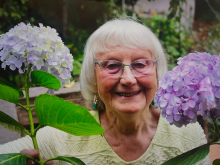
Clare Cooper Marcus
Professor Emerita of the Departments of Architecture and Landscape Architecture & Environmental Planning
The University of California, Berkeley, mourns the passing of Clare Cooper Marcus, Professor Emerita in the Departments of Architecture and Landscape Architecture & Environmental Planning in the College of Environmental Design (CED). An internationally recognized scholar and educator, Marcus leaves a profound legacy in environmental design research, pedagogy, and practice—one that reshaped how landscape architects, architects, and planners understand the relationship between people and place.
Marcus was widely known for her pioneering research into the psychological and sociological dimensions of architecture and landscape architecture. At UC Berkeley, she played a central role in developing CED’s groundbreaking social factors curriculum during the 1960s and 1970s, helping institutionalize a more humane, user-centered approach to the built environment at a time of significant cultural and academic transformation.
Born in London in 1934, Marcus earned a bachelor’s degree in historical geography from the University of London in 1955. She came to the United States in 1956 as a Fulbright scholar, completing a master’s degree in urban geography at the University of Nebraska before earning a Master of City Planning degree from UC Berkeley in 1965. She later held research positions at Berkeley’s Institute of Urban & Regional Development. Marcus joined the landscape architecture faculty in 1969 and the architecture faculty in 1971, teaching at the CED for 25 years before taking early retirement in 1994.
Trained as a geographer and deeply influenced by the human potential movement of the 1960s, Marcus consistently advocated for a user-centered approach to design in both her research and teaching. As her work gained international recognition, she became a leading figure in the development of post-occupancy evaluation of built environments as a rigorous research method. “Clare Cooper Marcus was a pioneer in developing the techniques of post-occupancy evaluation, a process now embedded in architectural practice,” says Charles Rice, professor of architecture at the University of Technology Sydney. “Her particular focus on housing always recognized an occupant's individually expressed needs, expectations, and experiences.”
Marcus’s scholarship focused on the environmental needs of vulnerable populations, including children, low-income families, and the elderly. Her landmark study of Easter Hill Village in Richmond, California, exemplified this commitment as it “was one of the first to find out if and to what extent the architects' intentions were experienced by residents,” says UC Berkeley Professor Emerita Galen Cranz. Marcus’s close attention to how children experienced life in this public housing community culminated in her 1975 publication Easter Hill Village: Some Social Implications of Design.
“She also focused on how individuals experienced their own homes,” Cranz continues, “which led to unearthing the unconscious influence of early environments on architects' later work and to her popular book House as Mirror of Self that got the attention of Oprah Winfrey.” That work, along with numerous other influential publications, translated empirical research on user behavior into accessible and actionable design guidance. Among these were Housing as if People Mattered: Site Design Guidelines for Medium-Density Family Housing (1986), co-authored with Wendy Sarkissian, and People Places: Design Guidelines for Urban Open Space (1990), co-authored with Carolyn Francis.
Alongside fellow CED faculty—including architect Roslyn Lindheim and sociologist William “Russ” Ellis—Marcus helped shape an academic culture that responded to the era’s calls for socially responsive and interdisciplinary design education. Together, they established courses and a PhD research track in architecture centered on social factors in design. Architects and social scientists team-taught studios intended to bridge theory and practice. Marcus later reflected in Design on the Edge, a history of Berkeley’s Department of Architecture, that these studios were meant to “facilitate the direct translation of social science concepts and research data to the drawing board.”
Marcus’s impact as an educator continues to resonate at Berkeley. Her course, Social and Psychological Factors in Open Space Design, remains part of the Department of Landscape Architecture & Environmental Planning's curriculum. She also taught seminars on housing design, environments across the life cycle, and sense of place. Former student and Master of Architecture Berkeley alumnus John Parman recalled that her class, The House as Symbol of Self, which later became a book, was wonderful. “She really believed in it, a reaction to her more orthodox sociological research that preceded it.” He added, “She wrote in an issue of the Journal of Architectural Education that she came to believe in the importance of intuition in research. I agree.” Class of 1972 landscape architecture Berkeley alumnus Robert Sabbatini similarly recalled Marcus’s lasting influence: “Her class taught me to critically observe the built environment and to apply these observations to my decades of work that followed. Truly an inspiration.”
Over the course of her career, Marcus received numerous honors, including an exemplary design research award from the National Endowment for the Arts, a career award from the Environmental Design Research Association, a Guggenheim Fellowship, a Lifetime Achievement Award from the Center for Health Design, and was awarded Merit awards from the American Society of Landscape Architects (ASLA) and the American Institute of Architects (AIA) for her publications.
Following her retirement from UC Berkeley, Marcus turned her scholarly attention to therapeutic landscapes in healthcare, a field that brought together her academic rigor and lifelong love of gardening. She published extensively, consulted on healthcare and senior living gardens, and co-authored Healing Gardens: Therapeutic Benefits and Design Recommendations with Marni Barnes (1999) and Therapeutic Landscapes: An Evidence-Based Approach to Designing Healing Gardens and Restorative Outdoor Spaces (2014) with University of Maryland professor and CED alum Naomi Sachs. “I think I literally jumped for joy when she asked me to co-author Therapeutic Landscapes,” says Sachs. “Clare’s writing was an inspirational combination of intelligence and straightforwardness… She was inquisitive, sharp, rigorous, and empathetic. She also had a delightful sense of humor.”
Marcus’s love of nature was rooted in her childhood in the English countryside during World War II. Over nearly five decades, she transformed the garden of her Berkeley home into a flourishing landscape that reflected her belief in the restorative power of place. At the time of her death, Marcus had just completed another memoir, Groundbreaking: My Unmapped Path as an Academic, Mother, and Gardener, scheduled for publication in May 2026 by New Village Press.
Berkeley Professor Louise Mozingo acknowledges that “Clare generously and wonderfully mentored me, and countless others, as we proceeded in our careers, providing a wise sounding board, but also new observations and insights to think about and a continuing sense of enthusiasm and adventure in contemplating the lived environment.” Her Berkeley colleague and Professor Emeritus Randolph Hester credits Marcus’ commitment to community “that infused our department with a shared destiny I experienced nowhere else; she made us all better academics and better human beings.” Marcus’s scholarship, teaching, and mentorship indelibly shaped the College of Environmental Design and the broader fields of architecture and landscape architecture. Her work continues to influence how designers, researchers, and students understand—and honor—the lived experience of people in the environments they create.
Professor Clare Cooper Marcus died on January 18, 2026, in her Elmwood home, facing her beloved garden. Surviving family members include her son, J. Cooper Marcus; her daughter, Lucy Hermione Marcus; her daughter-in-law, Angela Laffan; her grandsons, Myles and Remington; her brother, Anthony Cooper, in England; and numerous nieces and nephews, as well as great- and great-great-nieces and nephews, in Canada and England. Marcus was predeceased by her parents, her older brother Paul, and her former husband, Stephen Marcus, a landscape architect in San Francisco.

