
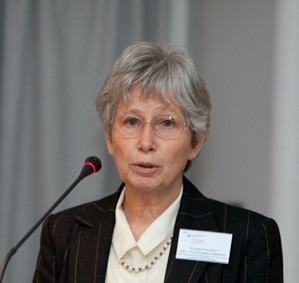
Elisabeth “Betty” Sadoulet
Professor of Agricultural and Resource Economics
Elisabeth “Betty” Sadoulet, a Professor of Agricultural and Resource Economics (ARE) at the University of California, Berkeley, was a leader in international economic development.
Born on October 4, 1945, in Lyon, France, Professor Sadoulet joined U.C. Berkeley in 1985 after receiving a PhD from the University of Geneva in 1982. During her illustrious career, Professor Sadoulet was the editor of the World Bank Economic Review and was a fellow of several scholarly associations, including the Agricultural and Applied Economics Association and FERDI in France. She worked in advisory capacity with the Government of Mexico, the Food and Agriculture Organization of the United Nations, the World Bank, and the United Nations University World Institute for Development Economics Research in Helsinki. At Berkeley, she served many years as faculty advisor for undeclared undergraduate students. She served on Berkeley’s Academic Senate’s Committee on Committees (2014-2015).
Cornell University Professor and longtime friend Erik Thorbecke observes that Professor Sadoulet’s impressive contributions effectively and harmoniously combined intellectual curiosity, rigor, humanism, a touch of skepticism, and a constant attempt at clarity. Professor Sadoulet acknowledged Angus Deaton, Irma Adelman, Abhijit Banerjee, and Esther Duflo for influencing her approach to economics as both a quantitative and an experimental discipline, in which rigorous analysis served as the basis for policy recommendations. Nobel Laureate Ester Duflo, a Professor at MIT, comments that when first meeting “Betty, her reputation as a scholar whose work was deeply rooted in the reality of life in low- and middle-income countries preceded her, and I was a little nervous.” MIT Professor Nobel Laureate Abhijit Banerjee sees “Betty Sadoulet as a unique heroic figure in her generation of development economists, kind and approachable, and committed to the social good, while deeply serious when it came to the quality of research. Always ready with a smile, but mindful of details and nuance. A mentor to a whole generation of outstanding Berkeley students and others.”
Throughout her career, Professor Sadoulet focused on how to make agriculture into an effective instrument for development, believing that it presents unique opportunities. Sadoulet published widely, including in The American Economic Review, The Economic Journal, the Journal of Development Economics, and World Development. In addition, Sadoulet co-authored two textbooks with Professor Alain de Janvry: Quantitative Development Policy Analysis (1995, 2003) and Development Economics: Theory and Practice (2016, 2021).
Professor Sadoulet was a longtime faculty member and an intellectual pillar in the Department of Agricultural and Resource Economics. The former Dean of the Rausser College of Natural Resources, Professor Gordon Rausser, remembers one of his happiest days was when Sadoulet was “unanimously and enthusiastically appointed as a tenured faculty member in ARE. Sadoulet elevated our standards like no one else, instilling in us a deep appreciation for rigorous empirical economic analysis and the critical importance of identification in isolating causality. We miss her presence every day and her warm, unmistakable smile.” She was “honest and unflinching in her pursuit of truth, generous in sharing her wisdom, and tireless in her dedication to her field, especially to our students. That she continued contributing meaningful work until the very end was characteristic of someone who saw scholarship not as a job, but as a calling,” recalls Professor Ethan Ligon. Professor Jeremy Magruder believes that “Betty was a mentor to all of us in the department - students and faculty alike - as she embodied the example of combining care and conscientiousness with rigor in solving big problems in economic development and training the next generation.” That “Berkeley will not be the same place without her” concluded her Economics Department colleague Professor Ted Miguel.
In tireless collaboration with Professor Alain de Janvry, Sadoulet helped shape the careers of successive generations of graduate students. “They hosted the legendary Friday workshop where graduate students would be rigorously questioned on their research. Betty was tough but fair. Many students who became leaders in their fields were shaped in that room, where Betty combined high expectations with a healthy dose of fear—always bringing out the best in people,” recalls ARE colleague Professor Marco Gonzalez-Navarro, a regular workshop participant. Even in retirement and during her final illness, she worked tirelessly with Graduate Advisor Carmen Karahalios and her colleague and Head Graduate Advisor, Professor Michael Anderson, to support ARE graduate students in navigating the ARE PhD program.
“You knew she had Friday office hours going when you saw 7 or 8 ARE PhD students lined up outside her office in Giannini. She diligently helped each one of those students, often staying well into the evening,” recalls former student, Tufts Professor, Kyle Emerick. Professor Shaoda Wang at the University of Chicago Harris School, and a former student, credits Professor Sadoulet as continuing “to support and inspire. Whatever I may take pride in professionally, I owe it to Betty.” Carly Trachtman, a former student now at IFPRI, credits Betty's mentorship and fierce loyalty to her students as key drivers of Carly’s success as a professional economist. Former student and colleague in the Department of Economics at Berkeley, Professor Frederico Finan, believes that “Betty was a passionate researcher and a dedicated advisor. But perhaps even more importantly, she was a generous human being who reminded us never to lose sight of the deeper purpose of our work—to improve the lives and opportunities of those living in poverty around the world.”
Former student Professor Karen Macours, now at the Paris School of Economics fondly remembers, "Betty as a role model who fundamentally shaped the way we understand economics and how to put it to good use, through her sharpness of thought, joint field work, feedback sessions, brainstorming, policy engagements, and dinners at her home, all while creating a community of friends through which her deep influence will live on." As he now mentors PhD students, University of Bordeaux Professor Tanguy Bernard observes that “as much as I can to live up to the guidance I received from Betty—grounding hypotheses in field observations, nurturing intuition, emphasizing the importance of rigor, and, most importantly, striving to make it all meaningful beyond academia.”
Pompeo Fabra Professor Gianmarco Leon credits Betty for “pushing me to my best with rigor and kindness, and I am eternally grateful to her for that.” Former student and World Bank Economist Abdou Cisse and his wife Khadija Diop hope that “her academic legacy, present all over the world, will make her absence more bearable. She leaves a strong, silent, and beautiful mark.”
Professor Sadoulet was the living embodiment of Berkeley: A world-renowned institution dedicated to making the world a better place through research, teaching, and service. The twinkle in Betty’s eye just before she delivered a brilliant insight—or asked a question that made us all tremble (if it was aimed at us!) but ultimately deepened our understanding of the world—is one of the two things we will miss most. The other is her giant heart.
Professor Sadoulet passed away on October 17, 2025, after a valiant battle with cancer. She died in Lyon, where she had spent her recent years since retiring. Surviving family members include Professor Alain de Janvry, Professor Bernard Sadoulet, her three children, Hélène, Loïc, and Samuel, and their spouses, her ten grandchildren, and her brother and two sisters, as well as spouses and nephews.
Alain de Janvry, Professor, Agricultural and Resource Economics
Sofia Berto Villas-Boas Chair, Department of Agricultural and Resource Economics

