
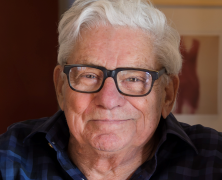
Andrew A. Stern
Senior Lecturer Emeritus, Graduate School of Journalism
Andrew Stern, who inspired a generation of students in broadcast journalism and documentary film making, died on June 27, 2023, in Berkeley.
He was born on January 10, 1931, in Munich, where his father was a well-known dealer in fine arts. The gathering storm of Nazism forced his family to take refuge first in Belgium with his grandparents, and in 1939, in New York City. Already trilingual at the age of 8, he immersed himself in school, fell in love with baseball (the Brooklyn Dodgers), and began to build a career as a journalist by founding a student newspaper at Columbia Grammar School and graduating as president of the senior class. He then attended Dartmouth College, spending a mind-opening year abroad at the Sorbonne in Paris. After graduation, he served in the U.S. Army (1952-1954) as an interpreter in France, where he made life-long friends.
After the Korean War, Andrew returned to the East Coast, and continued his work in journalism, at the Voice of America and then National Educational Television (NET), the precursor of PBS. He produced half-hour and hour-long programs on timely topics related to nuclear weapons, race relations, and arts and culture, including “Hiroshima, 1965,” and “Brunswick, GA: Quiet Conflict.”
In 1959 he met Mary Lou Wyatt, a researcher for labor unions, at a party in Washington D.C. Marriage followed and soon after, a move to New York City. In 1966, they adopted their daughter, Alexandra, who was educated and became a professor in the UC system. In 1969, the dean of the recently established Graduate School of Journalism at UC Berkeley asked Andrew if he was interested in coming out west for one year to try launching a broadcast journalism program. Enraptured by the Bay Area, that stint turned into more than 25 years as a faculty and more than 50 years residing in North Berkeley.
As a Senior Lecturer and Teaching Professor at Berkeley, Andrew taught memorable undergraduate courses and trained hundreds of students in the craft of documentary film making. A proponent of diversity, equity, and inclusion before it was branded as such, Andrew was a strong advocate for, and eventually hired, the queer Black documentarian Marlon Riggs; he mentored many pioneering women in journalism and always supported students with disabilities. He was an unwavering mentor to his students and became lifelong friends with many of them.
During this period, in 1981, Andrew produced the award-winning documentary, How Much is Enough? Decision Making in the Nuclear Age, which was filmed in the United States and Europe. This documentary was broadcast nationwide by PBS and in six European countries and received high praise including the George Polk Award, the Thomas Storke Award, the Edward Weintal Prize, and Best Documentary at the U.S. Film Festival Park City (which became the Sundance Film Festival).
After retiring in 1994, Stern spent five years traveling back and forth between his home in Berkeley and the former Soviet Union, where he coached an eager generation of young journalists and newly independent television stations in the processes and meaning of a free press. He travelled to several countries in Africa and Haiti, as part of the United States Information Agency’s programs to support journalism in the developing world.
In addition to his video documentary work, Andrew was an accomplished photographer, and an early adopter of the digital conversion of print images. His portfolios were shown at venues around the country. Most notably, his Appalachian portfolio of photos taken in the late 1950s and early 1960s – inspired by Mary Lou’s upbringing in North Carolina – were exhibited in Kentucky, Virginia and California in the early 2000s. His photographic work was recognized for its compassionate and no-nonsense portrayal of hard-scrabble life in eastern Kentucky.
Alexandra Minna Stern
Thomas C. Leonard
Thomas J. Goldstein

